Technical / Buying Guidance
Landscape Lighting Transformer Sizing Chart for Homeowners
8 min read
Sometimes you do not need a full calculator first. You just want a fast homeowner reference that tells you what size landscape lighting transformer you are probably buying.
This chart is built for that early planning step. It helps you get into the right 75-watt, 150-watt, 300-watt, or 600-watt range before you fine-tune zones, wire runs, and voltage-drop details.
Quick answer
Use a transformer sizing chart to get into the right neighborhood fast, then confirm the final decision with zone planning and voltage-drop checks.
Quick transformer sizing chart
This chart assumes a homeowner wants meaningful breathing room instead of running a transformer right at its limit. It is meant to guide practical buying decisions, not squeeze the maximum possible load onto each size.
| Connected fixture load | Typical homeowner scenario | Safer transformer target |
|---|---|---|
| Up to 45W | Small entry path, short walkway, a few accents | 75W transformer |
| 46W to 100W | Front yard with path lights plus one or two accent runs | 150W transformer |
| 101W to 180W | Larger front yard or front + side yard with multiple zones | 300W transformer |
| 181W to 360W | Front, side, and backyard loads or denser accent lighting | 600W transformer |
| Above 360W | Large residential layout or multiple heavy zones | Split loads or use multiple transformers |
These ranges are intentionally conservative so the transformer still has room for startup variation, future fixtures, and cleaner day-to-day operation.
How to use the chart without fooling yourself
The biggest value of a sizing chart is speed. It helps you avoid buying a transformer that is obviously too small or jumping straight to a much larger unit without knowing whether you actually need it.
It still works best as a first pass, not a final electrical answer. Transformer selection also depends on how the system is divided into zones, how long the runs are, and whether you expect to add fixtures later.
- Use actual fixture wattage when you have it
- Leave reserve capacity instead of sizing to the exact connected load
- Move to the planner or voltage-drop tool when runs get longer or layouts get more complex
Fixture-count examples for a fast second check
Many homeowners think in fixture counts before they think in watts. These examples are less precise than the planner, but they are useful for reality-checking a shopping list.
| Fixture mix example | Approximate connected load | Likely transformer choice |
|---|---|---|
| 8 path lights at 4W each | 32W | 75W transformer |
| 12 path lights at 5W each | 60W | 150W transformer |
| 10 path lights at 5W + 4 uplights at 7W | 78W | 150W transformer |
| 16 path lights at 5W + 6 uplights at 7W | 122W | 300W transformer |
| 20 mixed fixtures averaging 8W each | 160W | 300W transformer |
| 30 mixed fixtures averaging 8W each | 240W | 600W transformer or split zones |
Real fixture wattages vary by brand, lamp type, beam spread, and integrated-LED design. Use the planner when you are working from actual spec sheets or product pages.
Use fixture count as a reality check, not the main sizing method
A transformer-sizing chart gets you into the right wattage neighborhood quickly, but homeowners still tend to ask the question in fixture-count language: how many lights can one transformer really handle?
That is a useful second check, not the first one. Once the chart points you toward a transformer size, sanity-check the result against the number of path lights, uplights, and mixed fixtures you expect on the zone so the plan still feels believable in the yard.
- Use wattage to choose the transformer range
- Use fixture count to catch obviously overloaded zone plans
- Move to the planner when one transformer may serve several different yard areas
What to do next if the plan is getting more complicated
A simple chart is enough for rough buying guidance, but longer runs and mixed zones can still create bad results if you stop here. The next step is to move into actual zone planning and voltage-drop checking.
That is especially important if the farthest fixtures are a long way from the transformer, if you may add more lights later, or if one part of the yard carries a heavier load than the others.
- Use the transformer planner when you need zone-by-zone totals
- Use the voltage-drop calculator for longer runs
- Use the wire-gauge calculator when the cable choice is still unclear
Deeper reference
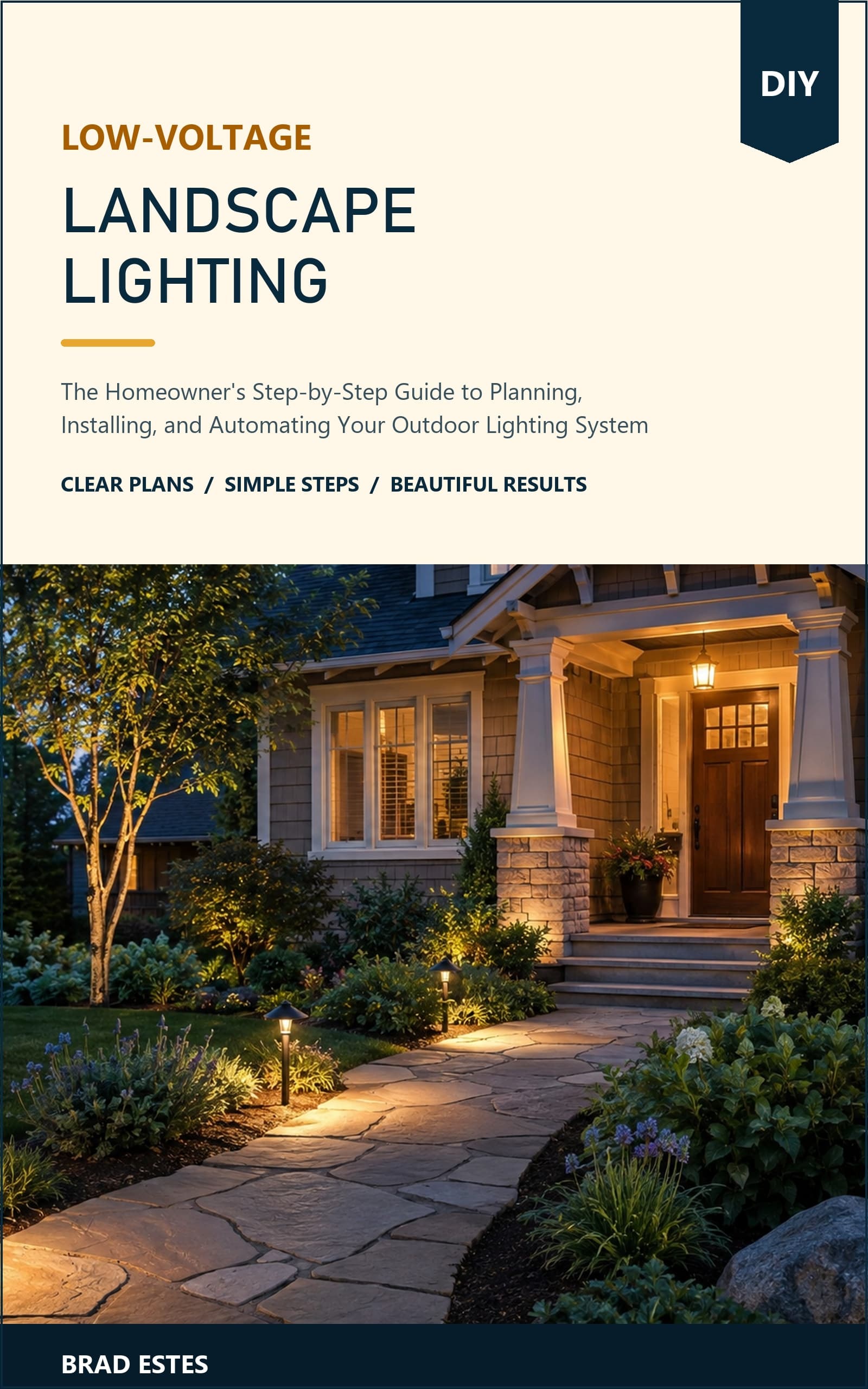
Keep the full homeowner guide on hand.
The book goes deeper on fixture selection, transformer sizing, wiring, voltage drop, automation, and building a landscape lighting plan from the first sketch through the final night look.
Next steps
If this page answered the first question, these are the next pages worth opening.
Landscape Lighting Transformer Planner
Use the chart for a fast first pass, then move to zone-by-zone planning when the layout starts getting real.
How Many Landscape Lights Can You Put on One Transformer?
Open the fixture-count guide when you want to translate the chart range into a more practical zone conversation.
Landscape Lighting Voltage Drop Calculator
Check longer runs once the chart puts you in the right transformer neighborhood.
Frequently asked questions
What size transformer do I need for landscape lighting?
The right size depends on your total connected fixture wattage plus reserve capacity. Many homeowners land in 75W, 150W, 300W, or 600W ranges, but the correct choice also depends on zones, run length, and future expansion.
Can I size a transformer exactly to my fixture wattage total?
That is usually not the safest homeowner move. Leaving headroom helps the system handle variation more comfortably and gives you room for added fixtures later.
When should I choose a 300-watt transformer instead of 150 watts?
A 300W transformer often makes more sense once the real fixture load moves beyond roughly 100 watts, when the yard is being split into more than one meaningful zone, or when future expansion is likely.
Does a bigger transformer solve voltage drop?
Not by itself. Voltage drop is often a wire-length, gauge, and layout issue. A larger transformer can still perform poorly if the cable path or zone design is weak.
Recommended products
Amazon picks that fit this guide
These are starter products tied to the decision this page is helping with. Use the guide's planning advice and the product specifications together before you buy.
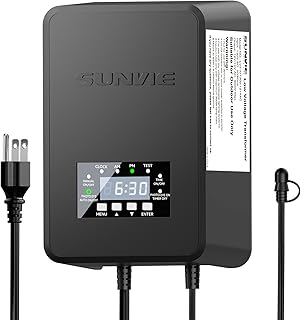
SUNVIE 200W Landscape Lighting Transformer with Timer and Photocell
A practical mid-size transformer pick for homeowners moving beyond a small path run and wanting built-in timer and dusk-to-dawn control.
View 200W transformer
DEWENWILS 300W Wi-Fi Low Voltage Landscape Transformer, 3 Zones
A larger-capacity option for bigger front-yard plus side-yard layouts where separate zones and more headroom start to matter.
View 300W transformer
Gardner Bender GET-3202 Low Voltage Tester
A simple low-voltage tester that helps homeowners verify whether the plan on paper is translating into usable voltage at the fixtures.
View low-voltage testerDisclosure: As an Amazon Associate, this site may earn from qualifying purchases at no extra cost to you.