Planning & Layout
How Far Apart Should Path Lights Be?
10 min read
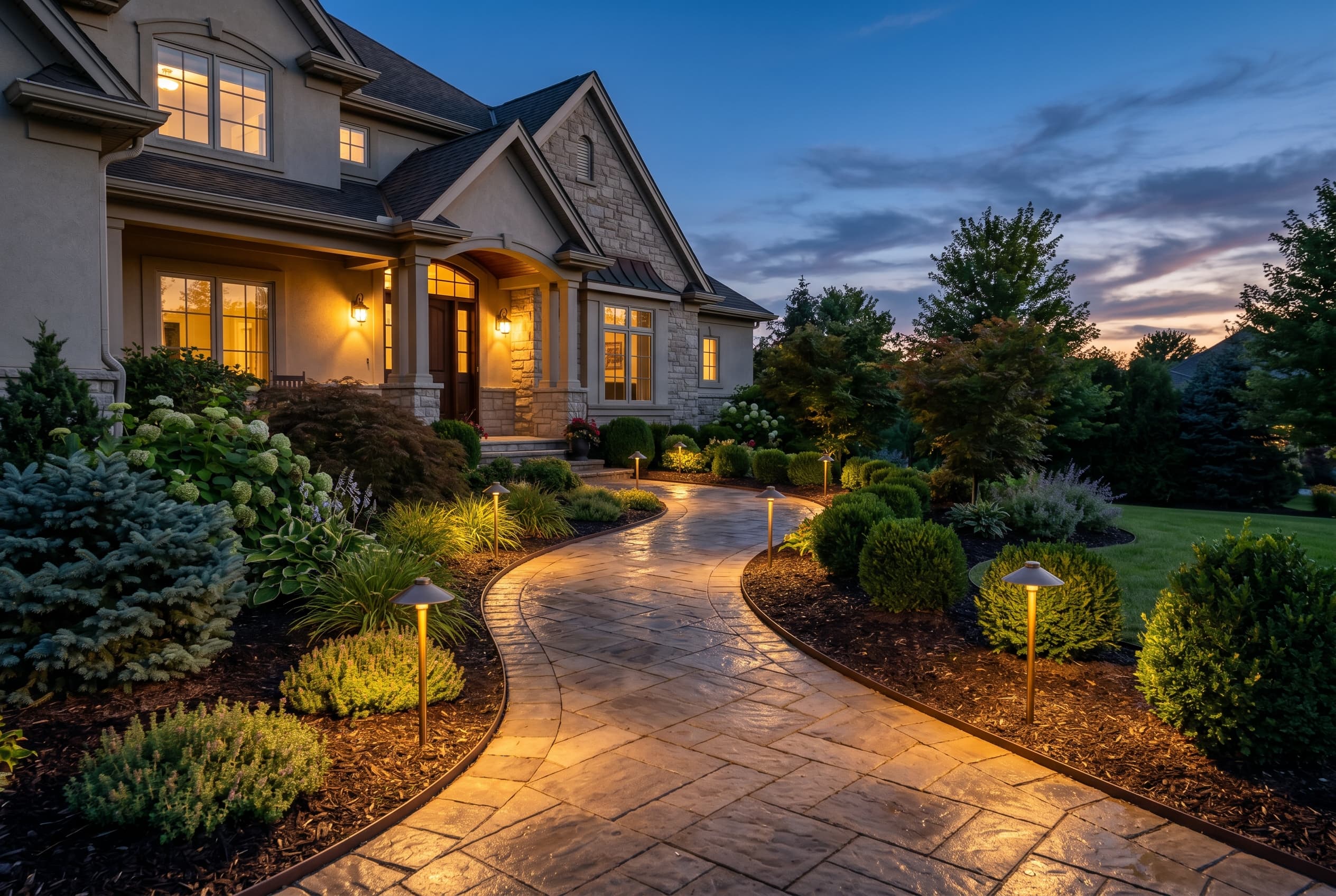
For most residential walkways, begin with path lights about 6 to 10 feet apart. That is a starting range, not a rule: the right final distance is the one that lets the pools of light overlap softly, keeps turns and changes in elevation readable, and does not put glare in a guest's eyes.
Path lights are one of the easiest fixtures to overuse. Too few and the route disappears. Too many and the path looks like an airport taxi lane. Landscape Lighting Planner's point of view is simple: light the decisions people make while walking, then let the dark areas stay quiet.
Quick answer
Start around 6 to 10 feet apart, mock the layout up after dark, and keep only the fixtures that create soft overlap, clear transitions, and a welcoming rhythm instead of a dotted runway.
Use a spacing range, then test the actual light pool
A compact, low-output path light may need to sit closer to its neighbor than a fixture with a wider, softer distribution. Start with a few fixtures temporarily placed at roughly 6 to 10 feet apart, switch them on after dark, and move them before you make the installation permanent.
A short, straight walk with broad, gentle pools may look right closer to the 8-to-10-foot end of the range. A narrow walk, a tight curve, a step, or a change in direction may need a closer visual cue. What matters is continuous route recognition, not mechanically equal measurements.
| Walkway condition | Practical first pass | What to check at night |
|---|---|---|
| Straight, open residential walk | Start around 8 to 10 feet apart | The light pools should meet softly without making bright circles. |
| Narrow walk, curve, or planting-heavy edge | Start around 6 to 8 feet apart | Look for readable edges and avoid a dark gap at the turn. |
| Steps, grade change, or a junction | Add a deliberate cue near the transition | Make the change visible without aiming a bright source at faces. |
| About a 28-foot straight span | Mock up three or four fixtures before committing | Choose the count that gives soft overlap with the fixtures you actually own. |
These are first-pass layout ranges, not a substitute for fixture photometrics or an after-dark mockup. Fixture height, shield shape, output, mounting height, surface color, and surrounding planting all change the result.
Place lights at decisions, not every few feet
The biggest mistake is treating every few feet as a mandatory fixture location. In most yards, that creates visual clutter and more brightness than the space needs. A better layout gives extra attention to the beginning and end of the walk, a turn, a branch toward the driveway, a gate, or a step.
On wider walks where fixtures can live on either side, stagger them rather than making a rigid pair opposite each other. Staggering creates a more natural rhythm and usually prevents the tunnel effect that happens when both sides mirror each other too precisely.
Deeper reference
Keep the full homeowner guide on hand.
The book goes deeper on fixture selection, transformer sizing, wiring, voltage drop, automation, and building a landscape lighting plan from the first sketch through the final night look.
Choose the fixture before you lock the spacing
The fixture is not just a decorative stake. Its shade, diffuser, height, shielding, and output decide whether the walkway receives a broad, quiet pool or a concentrated bright spot. The spacing should follow that behavior instead of a fixed formula copied from another yard.
Traditional path-and-area lights are the familiar short fixtures with a hat or tiered shade. They are a practical default for most residential walks because they put a soft pool onto the paving and nearby planting. A bollard is a taller, more architectural post; it can define a wide entry or drive edge, but the added height makes shielding and glare control more important. In-ground fixtures keep the hardware nearly invisible, but they are better used as an accent or a carefully planned transition light than as the only way to make a whole walkway readable.
- Wide, shielded path-and-area lights can often sit farther apart because they create a broad, low-glare pool.
- Compact or more directional fixtures may need closer placement, especially at a curve or along a narrow walk.
- Bollards can give an entrance more presence, but select a shielded distribution and test the view from the approach; a taller glowing source can be more distracting than a smaller path light.
- In-ground fixtures work best for a clean-lined edge, a step, or a special architectural moment. They need drainage, durable lenses, and a plan for leaves and debris before they become a maintenance headache.
- Tall, exposed lamps can create glare even when the walking surface looks bright enough; lower glare is usually more valuable than more lumens.
- Several restrained fixtures often look better than a few harsh, high-output fixtures, but only when each one has a job to do.
Low-voltage is the better system choice for a planned walkway
For a walkway you expect to keep and expand, a wired low-voltage system usually gives the homeowner more consistent output, shared control, replaceable planning choices, and a clearer path to adding accents or step lighting later. It also asks you to plan the transformer, cable route, fixture load, and voltage drop instead of treating each light as an isolated purchase.
Solar path lights can be useful as a temporary test, a small remote accent, or a low-commitment experiment. They are harder to count on under tree cover, in winter, or when the walkway needs dependable, matching output. Do not use a sunny product photo as proof that a solar fixture will create the same after-dark rhythm in your yard.
Plan the path lights as one part of the system
A path-light layout becomes more reliable when it is planned alongside the transformer, wire route, and future fixtures. A short front walk may be simple; a long side yard or a path that shares cable with uplights and step lights needs a real load and distance check before you buy everything.
Keep the first path-light mockup modest, then make sure the final plan has transformer headroom and a cable layout that will not leave the far end dimmer than the beginning. This is the difference between adding lights and building a system that can grow gracefully.
- Total the wattage of every fixture that will share the transformer, then leave headroom for additions.
- Check longer runs for voltage drop before fixtures go in the ground.
- If a path branches toward a patio, driveway, or side gate, consider whether separate cable paths or zones will make future changes easier.
Avoid the mistakes that make a walkway feel cheap
The common failure is not simply too much or too little light. It is a collection of small decisions that make the source more noticeable than the route: fixtures installed in a ruler-straight line regardless of the landscape, every fixture aimed at the viewer, one overly bright lamp next to several dim ones, or a dark gap exactly where the walk turns.
Walk the route with a guest's point of view. Look down the path, back toward the house, and from the street. If the first thing you notice is a string of glowing dots, reduce glare, reconsider placement, or remove a fixture before adding more.
- Do not line both sides of a narrow walk with perfectly matched fixtures unless the setting truly needs it.
- Do not place a fixture where its bare lamp shines into a person's line of sight from the approach or front door.
- Do not assume a long run can use the same spacing all the way through; turns and transitions deserve their own decision.
- Do not buy a full kit until you have checked its fixture output, low-voltage compatibility, transformer capacity, and cable plan.
Product decisions that matter more than a brand name
Before choosing any path-light kit, compare the attributes that affect the finished walkway: a shielded or diffused light source, a warm color temperature around 2700K to 3000K, a fixture shape that directs light down instead of into eyes, a realistic output specification, and a low-voltage system that can be wired and expanded cleanly.
For a wired plan, match the fixture decision with a properly sized transformer, outdoor-rated low-voltage cable, and connectors suited to the actual layout. Review the fixture specification and the full system plan together rather than buying a kit based on fixture count or a product photo alone.
Next steps
If this page answered the first question, these are the next pages worth opening.
Frequently asked questions
How far apart should path lights be?
For many residential walks, start around 6 to 10 feet apart, then adjust after dark for the fixture's real light pool, glare, curves, steps, and planting. The goal is soft overlap and a readable route, not equal measurements at every point.
How many path lights do I need for a 28-foot walkway?
Three or four fixtures are a sensible first mockup for a straight 28-foot span, depending on fixture spread and where the walk begins, ends, or turns. Place them temporarily and judge the result at night before installing the final locations.
Should path lights go on both sides of a walkway?
Not automatically. On a narrow walk, a staggered single-side layout can guide the route with less clutter and glare. Use both sides only where the width, landscape, or transition genuinely needs more definition.
Are solar path lights or low-voltage path lights better?
Solar can be useful for a small temporary experiment or remote accent, but a planned low-voltage system is usually the more dependable choice for a main walkway because output, control, and expansion are more consistent. Solar performance depends heavily on real sun exposure, season, and battery condition.
Why do my path lights look like a runway?
The usual causes are too many fixtures, equal spacing everywhere, bright exposed lamps, or lights placed directly opposite each other along a narrow walk. Reduce glare first, then keep the fixtures that clarify turns, transitions, and the destination.
Recommended products
Amazon picks that fit this guide
These are starter products tied to the decision this page is helping with. Use the guide's planning advice and the product specifications together before you buy.

VOLT Stratum Brass Path & Area Light with 2700K LED Bulb
A single solid-brass, low-voltage path-and-area fixture for a homeowner building a durable wired walkway system and wanting a broad, warm pool of light.
View wired path light
GIGALUMI Warm White Solar Pathway Lights, 8-Pack
A simple solar option for a small accent area or a low-commitment experiment before committing to a wired system. Keep in mind that it needs dependable direct sun and will not offer the control or consistency of low voltage.
View solar path lightsDisclosure: As an Amazon Associate, this site may earn from qualifying purchases at no extra cost to you.