Technical / Buying Guidance
Landscape Lighting Wire Gauge Chart for Homeowners
8 min read
Most homeowners hear that 12-gauge cable is common and stop there. The better question is when 12 AWG is comfortable, when it starts getting borderline, and when 10 AWG is the smarter move.
This chart is built for that decision. It is a fast reference before you move into the full wire-gauge or voltage-drop calculators.
Quick answer
The right wire gauge choice is really a distance-and-load decision, and the chart helps you spot when 12 AWG stops being the obvious answer.
Think in distance and load together
Wire gauge decisions go bad when people focus on only one variable. A short run with a light load behaves very differently from a long run carrying a more ambitious zone.
That is why the chart below compares gauge choice against both run length and the amount of wattage you are trying to carry.
- Shorter + lighter runs usually give you more freedom
- Longer + heavier runs make gauge choice more important
- Gauge is part of layout planning, not just a materials detail
Quick wire gauge chart for common residential situations
Use this chart to decide whether 12 AWG still feels reasonable or whether the run is drifting into 10 AWG territory.
| Run length | Typical connected load | Usually workable gauge | Planning note |
|---|---|---|---|
| Up to 50 ft | Up to 60W | 12 AWG | Usually a comfortable homeowner starting point |
| 50 to 100 ft | Up to 60W | 12 AWG | Often workable, but still worth checking voltage drop |
| 50 to 100 ft | 60W to 120W | 12 AWG or 10 AWG | This is where the calculator becomes more useful |
| 100+ ft | Up to 60W | 10 AWG often safer | Long distance starts to matter more than people expect |
| 100+ ft | 60W to 120W | 10 AWG strongly worth considering | Borderline enough that layout and branching should be reviewed |
| Long run + heavy zone | 120W+ | 10 AWG or layout changes | Split the load before assuming one long cable path is fine |
These ranges are intentionally practical rather than overly precise. Exact conductor specs, branching layout, and acceptable voltage drop still matter on the final design.
What usually pushes a run into heavier wire territory
A homeowner run rarely becomes risky because of one variable alone. The problem is usually a stack-up: longer wire, more fixtures, and a layout that asks too much from one path.
Heavier cable can help, but sometimes the better move is to split the run so the system is not fighting itself.
- One long path carrying too many fixtures
- Trying to keep distant fixtures as bright as the near ones
- Adding backyard or side-yard fixtures onto an already stretched front-yard run
When to move from the chart into the calculators
If the chart lands you in the gray area between 12 AWG and 10 AWG, stop guessing and use the calculators. That is where the exact run distance and wattage start to matter more than the general rule.
Check voltage drop first, then compare gauge options, and keep the transformer load in the same planning conversation.
- Use the wire gauge calculator to compare cable sizes directly
- Use the voltage drop calculator when the run is long or the load is creeping up
- Use the transformer planner if the zone totals are still rough
Deeper reference
Keep the full homeowner guide on hand.
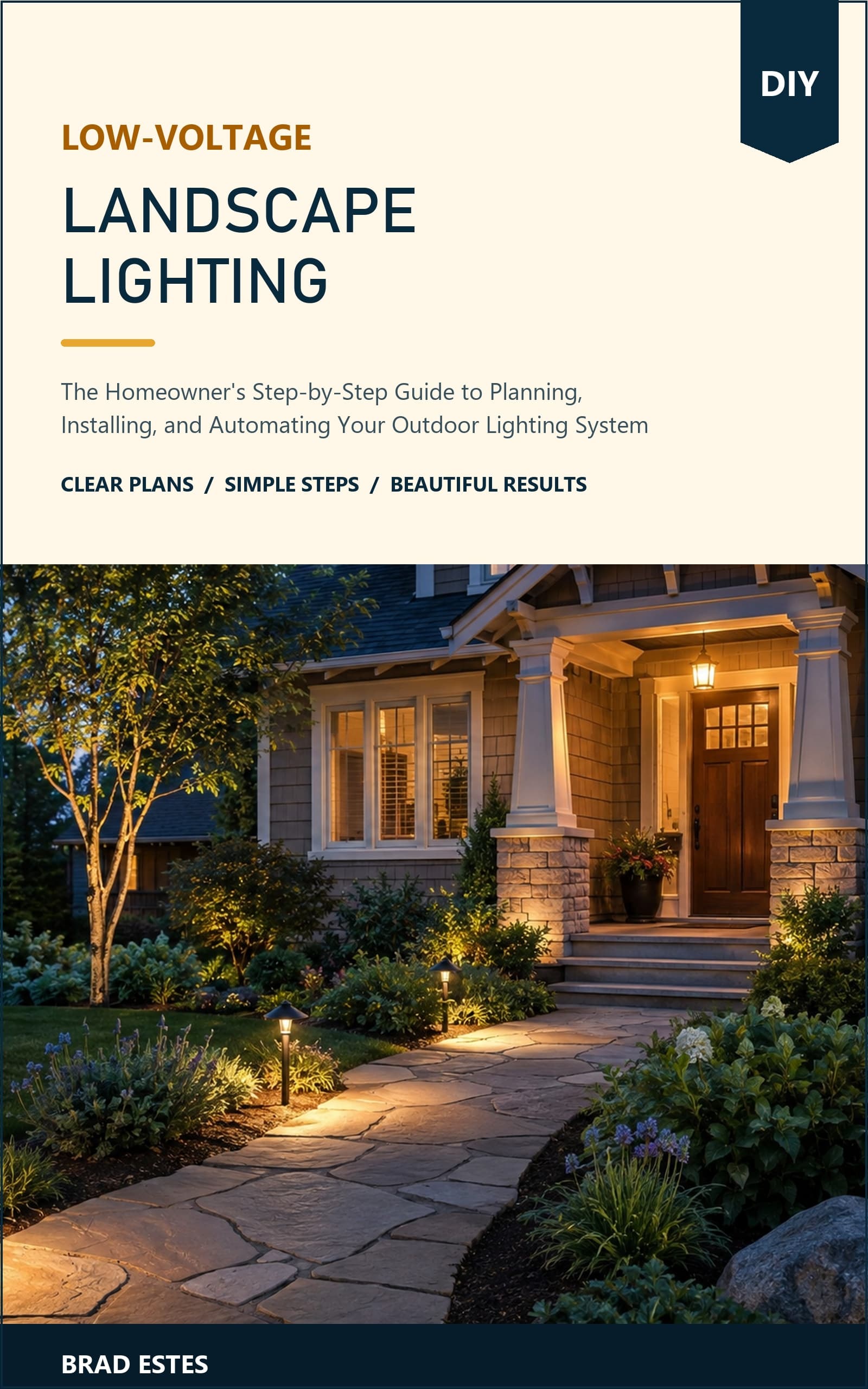
The book goes deeper on fixture selection, transformer sizing, wiring, voltage drop, automation, and building a landscape lighting plan from the first sketch through the final night look.
Next steps
If this page answered the first question, these are the next pages worth opening.
Frequently asked questions
Is 12 gauge wire enough for most landscape lighting?
Often yes for shorter or lighter residential runs, but not always. Once the run gets longer or the load increases, 10 AWG can become the better planning choice.
When should I use 10 gauge landscape lighting wire?
10 AWG becomes more attractive when the run is longer, the connected load is heavier, or the far fixtures need better protection from voltage loss.
Can heavier wire fix every landscape lighting problem?
No. Heavier wire helps, but layout still matters. If one cable path is carrying too much distance and load, splitting the run may be the smarter fix.
Should I use a wire gauge chart or a calculator?
Use the chart for a fast first pass and the calculator when the decision sits in the gray area or the run is important enough that guessing feels risky.
Recommended products
Amazon picks that fit this guide
These are starter products tied to the decision this page is helping with. Use the guide's planning advice and the product specifications together before you buy.

SUNVIE 12/2 Low Voltage Landscape Wire, 100 FT
A straightforward 12 AWG pure-copper option for shorter residential runs where 12/2 is still the practical choice.
View 12/2 wire
SUNVIE 14/2 Low Voltage Landscape Wire, 100 FT
A middle-ground 14 AWG option when the run is asking for more help than 12/2, but you do not want to jump all the way to a heavier cable.
View 14/2 wire
King Innovations Blazing BVS-2 Snap Lock Low Voltage Wire Connectors, 20-Pack
A connector add-on for homeowners comparing not just cable gauge, but also what they will need to finish and service the install cleanly.
View connectorsDisclosure: As an Amazon Associate, this site may earn from qualifying purchases at no extra cost to you.